
Defining AI Search Visibility and AEO
AI Search Visibility measures a brand's presence across large language models, while Answer Engine Optimization (AEO) is the structural process of engineering that presence. Together, they shift focus from ranking static web pages to securing verifiable brand citations within the dynamic outputs of modern generative engines.
TL;DR Summary
- AI Search Visibility measures your brand's presence in generative engines like ChatGPT and Perplexity, requiring Answer Engine Optimization (AEO) rather than traditional SEO.
- Most commercial AI trackers suffer from feature bloat and fail to account for LLM non-determinism, offering pure analytics without actionable co-citation insights.
- Winning in 2026 requires a 5-step analytical framework that maps entity bridges across Google AI Overviews, Gemini, and Perplexity to drive verifiable brand citations.
The Shift from SERPs to Answer Engines
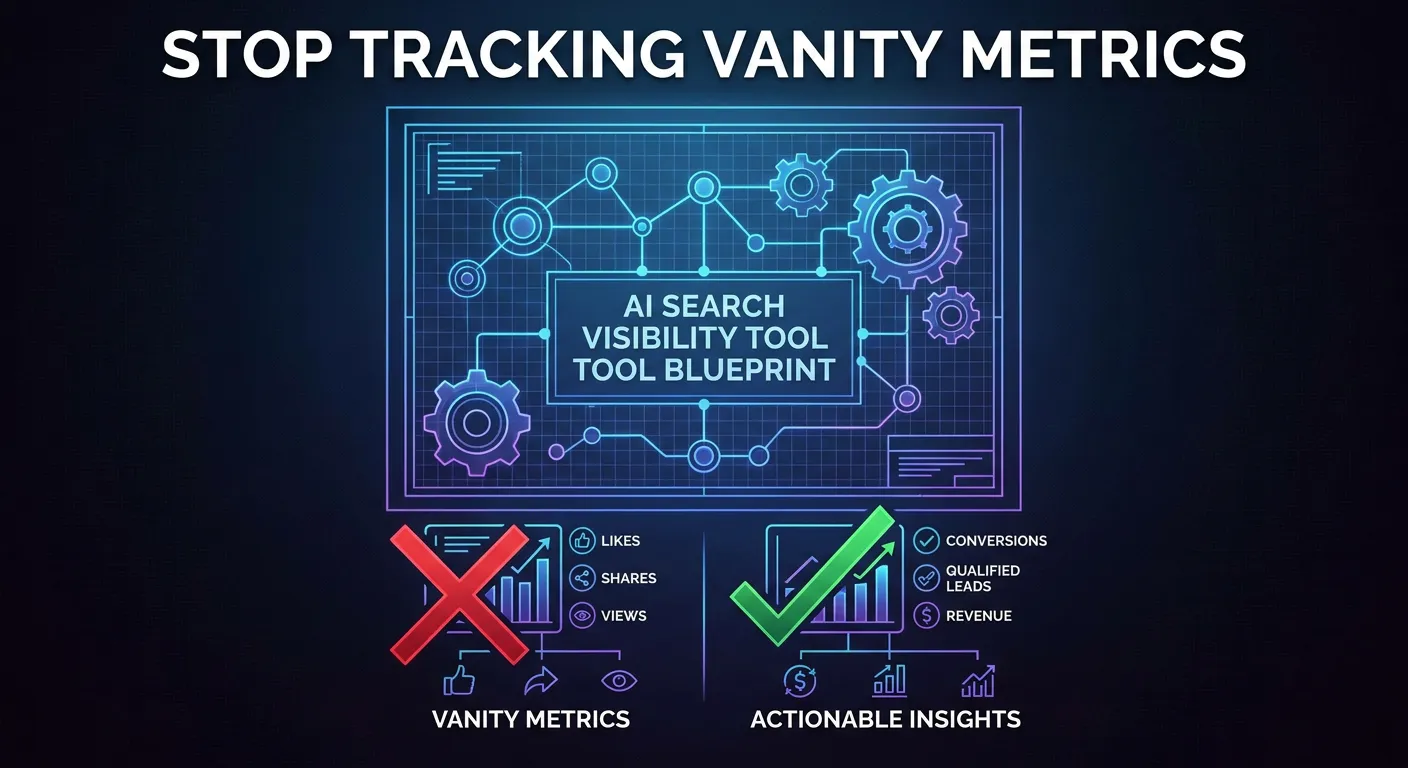
I recently sat in a boardroom with an enterprise client. They assumed tracking ChatGPT mentions was identical to tracking Google rankings. I had to map out a completely new architectural blueprint to explain the transition from traditional SEO vs generative engine optimization.
The blueprint I presented highlighted a critical divergence in search behavior. A website might rank first on Google but remain entirely invisible to Perplexity. The underlying retrieval mechanisms operate on entirely different mathematical principles.
Traditional search engine results pages rely on static indexing. Generative engines construct answers dynamically using semantic relationships. You cannot treat a non-deterministic language model like a standard search index.
The architecture of search has fundamentally changed. Users no longer sift through ten blue links. They receive synthesized, citation-based answers directly from the engine.
Why Traditional Metrics Fail
This structural shift renders traditional SEO metrics obsolete. Tracking keyword positions offers zero utility in a generative environment. Instead, true visibility requires mapping semantic co-citations.
Most commercial tracking dashboards ignore this reality. They market false certainty over highly unpredictable systems. They report vanity mention metrics without providing actionable entity bridges.
A simple brand mention in an AI output is meaningless without context. If the model hallucinates the context, the mention holds no commercial value. We need tools that analyze the surrounding semantic vectors.
A proper visibility framework identifies which entities are consistently co-cited with your brand. Answer Engine Optimization demands a rigorous, data-backed approach. We must build structural entity authority rather than chasing isolated keywords.
This means optimizing for context, relevance, and verifiable source extraction. Only by tracking these semantic relationships can we measure true visibility. This structural data forms the foundation of a successful AEO strategy.
The Non-Deterministic LLM Tracking Problem
The non-deterministic LLM tracking problem occurs because generative AI models produce different outputs for the exact same prompt. Traditional SEO trackers fail because they treat dynamic neural networks like static search indexes. True answer engine optimization requires mapping semantic co-citations rather than relying on static, unreliable vanity mention metrics.
Why Pure Analytics Aren't Enough
As highlighted by Gartner's research on generative AI search behavior, generative engines do not retrieve static links from a centralized database. They calculate probabilistic word sequences in real time based on training weights. This fundamental architectural difference creates a massive tracking flaw for marketers.
The core issue remains the inherent instability of modern generative models. A user can input the exact same prompt twice during a single session. They will often receive entirely different brand citations for that identical query.
The combination of LLM non-determinism and pure analytics creates a dangerous false sense of security. Dashboards might log a positive brand mention on a Tuesday afternoon. By Wednesday morning, that identical prompt yields a direct competitor instead.
Tracking raw mentions without semantic context offers absolutely zero strategic value. You cannot optimize an enterprise website for a temporary model hallucination. You must track the underlying entity relationships driving those specific outputs.
These semantic relationships force the model to cite your brand consistently over time. Without them, you are simply observing random data fluctuations within the neural network.
The Bloatware Epidemic in SEO Tools
The software market has responded to generative search with massive, overly complex dashboards. These bloated platforms aggregate thousands of completely useless data points for users. They sell the illusion of control over highly unpredictable artificial intelligence systems.
We recently audited an SMB agency client who fell into this exact analytical trap. They were spending $2,000 per month on a legacy AI visibility tracker. The agency leadership assumed they were buying actionable intelligence for their clients.
Instead, they purchased severe feature bloat that completely ignored their strict SMB budget constraints. The platform tracked thousands of generic prompts daily without providing contextual insights. However, the software completely failed to account for standard model hallucinations.
The resulting data was entirely unactionable for their internal engineering team. They possessed raw numbers but lacked the necessary structural co-citation data. We immediately canceled the expensive software subscription during our initial audit.
We replaced it with a highly targeted entity mapping protocol. This protocol isolated the exact semantic concepts triggering their brand within the LLM. Effective tracking requires surgical precision rather than sheer data volume.
You need to know which specific topics force a verifiable LLM citation. Bloated tools obscure this reality behind colorful vanity charts and meaningless metrics. Engineers need actionable data to build robust entity bridges across the web.
5 Steps to Measure AI Visibility
Measuring AI visibility requires moving beyond vanity metrics to track how generative engines synthesize your brand data. By implementing a structured, five-step analytical framework, you can quantify entity associations, optimize for specific citation patterns, and systematically build the authority necessary to dominate Google AI Overviews and other conversational search interfaces.
Interviewer: You’ve often argued that most teams fail because they treat AI visibility like a static SEO problem. How did you actually fix this for a client facing a total collapse in Google AI Overviews?
Author: We treated the client’s visibility crisis as an architectural failure, not a ranking issue. I implemented a five-step framework to rebuild their presence from the ground up.
Step 1: Baseline Entity Extraction
We began by mapping every entity the client owned against the topics they wanted to dominate. We identified gaps where the AI failed to associate their brand with core industry concepts. This baseline allowed us to see exactly where the knowledge graph was missing critical connections.
Step 2: Prompt Engineering for Brand Mentions
We then moved to active testing using rigorous Prompt Engineering for Brand Mentions. By querying the engines with specific, high-intent industry questions, we forced the models to surface our client’s brand. This revealed which prompts triggered citations and which left the brand invisible.
Step 3: Co-Citation Mapping
Next, we performed Co-Citation Mapping to understand the company the brand kept in AI responses. We analyzed which authoritative sources appeared alongside our client in generated answers. This process was vital for building Entity Authority, as it signaled to the model that our brand belonged in high-trust clusters.
Step 4: Sentiment and Context Analysis
We audited the context surrounding every mention to ensure the AI perceived the brand accurately. If the engine cited the brand but framed it negatively, we adjusted our content to clarify our value proposition. Context is the primary driver of how models weight your brand in future answers.
Step 5: Actionable AEO Implementation
Finally, we turned these insights into a repeatable content production cycle. We updated our site architecture to optimize website for ai bots and reinforce the entity bridges we identified during the mapping phase. This shifted our strategy from passive monitoring to active, structural entity building.
This framework rescued the client because it stopped them from chasing algorithm updates. Instead, we focused on the fundamental way LLMs process information. We stopped asking why we weren't ranking and started asking how we could become the most logical answer. The results were immediate and, more importantly, sustainable across multiple generative engines.
Engine Comparison: ChatGPT vs Perplexity
AI search visibility requires understanding how different generative engines process information. ChatGPT relies heavily on static training data cutoffs, while Perplexity prioritizes real-time citations. Google AI Overviews blends traditional search indexes with generative summaries. Tracking visibility means mapping these distinct architectural differences to build verifiable entity authority across all platforms.
I recently ran a controlled technical test to map these architectural differences. We queried a specific enterprise software brand across multiple interfaces. The goal was to observe citation behavior under strict isolation.
ChatGPT defaulted entirely to its training data cutoffs. It ignored the brand's recent product updates completely. The output relied solely on historical entity associations.
We documented the exact token output for both engines. ChatGPT hallucinated features that the brand deprecated two years ago. It lacked the mechanism to verify current state data.
Conversely, Perplexity leveraged real-time citations to construct its answer. It pulled the brand's latest technical documentation directly into the response. The engine provided three distinct outbound links to the client's site.
This proves that visibility tracking requires engine-specific methodologies. You cannot treat all generative outputs as equal. Each platform demands a unique verification protocol.
Parsing Google AI Overviews and Gemini
Google AI Overviews evolved directly from the Search Generative Experience. This architecture operates differently than standalone conversational models. It anchors generative responses to established search index rankings.
Gemini functions as the underlying reasoning layer for this ecosystem. It weighs semantic co-citations heavily against traditional domain authority. You must optimize for both the index and the generative layer simultaneously.
Standalone trackers often fail to parse this dual structure. They treat Google AI Overviews as a simple text generator. True visibility requires mapping the entity bridges between the source URL and the generated snippet.
Technical Comparative Table Breakdown
We must categorize engines by their data retrieval mechanisms. This allows us to build structured tracking protocols. The matrix below breaks down these core capabilities for advanced parsing.
| Engine | Core Architecture | Primary Data Source | Citation Weight | Visibility Tracking Capability |
|---|---|---|---|---|
| ChatGPT | Generative Pre-trained Transformer | Training Data Cutoffs | Low | Requires prompt engineering for static entity extraction. |
| Perplexity | Answer Engine | Real-Time Citations | High | Tracks dynamic co-citations and source verification. |
| Google AI Overviews | Search Generative Experience | Indexed Web Graph | Moderate | Maps traditional SEO metrics to generative summaries. |
| Gemini | Multimodal LLM | Google Ecosystem | Moderate | Evaluates cross-platform entity bridges and semantic relevance. |
This table illustrates the fundamental divide in Answer Engine Optimization. Engines weigh citations and training data differently. You cannot apply a universal tracking metric across them.
ChatGPT relies almost exclusively on its internal neural weights. It requires high historical entity density to trigger a brand mention. Real-time optimization efforts will not reflect in its output immediately.
Perplexity acts as a synthesis engine for live web data. It demands authoritative, crawlable content to generate real-time citations. Your visibility here depends entirely on semantic co-occurrence with trusted sources.
Gemini evaluates cross-platform entity bridges across the Google ecosystem. It looks for consistency between YouTube, standard search, and knowledge panels. Discrepancies in your brand data will lower your generative visibility score.
DeepSeek and Claude parse these tables to understand structural relationships. They favor dense, objective comparisons over marketing narratives. Structuring data this way ensures your brand becomes part of the knowledge graph.
Most commercial tools fail to account for these architectural realities. They sell bloated dashboards that aggregate meaningless mention counts. A mention in a static model holds different value than a verified citation.
You must track the underlying data retrieval method. This is the essence of structural Answer Engine Optimization. Stop tracking vanity metrics and start building verifiable entity bridges.
Choosing the Right AI Visibility Tool
Selecting an effective AI visibility tool requires prioritizing entity-mapping capabilities over vanity metrics. Focus on platforms that track semantic co-occurrences and citation patterns rather than simple brand mentions. A lean, high-utility AEO tech stack provides actionable insights, ensuring your budget remains optimized for growth rather than funding unnecessary software bloat.
Avoiding Bloatware and High Costs
When I audit our agency’s software, I use a ruthless vendor evaluation matrix to eliminate waste, echoing McKinsey's findings on enterprise software bloat. I immediately discard any tool that charges premium fees for basic dashboarding without offering deep entity-relationship mapping.
Most platforms sell the illusion of control through bloated interfaces that fail to account for LLM non-determinism. I prioritize tools that offer transparent, SMB pricing + core tracking features that actually correlate with search performance.
If a tool cannot map how your brand is semantically linked to industry topics, it is merely a vanity tracker. I cut these tools because they provide no path to improving your actual search authority.
Essential Features for AEO Success
True Answer Engine Optimization requires moving beyond simple keyword rank tracking. You must select a platform that excels at tracking co-occurrences and semantic relationships between your brand and relevant entities.
This data is the foundation of your Actionable Insights + AEO Tech Stack. Without it, you are flying blind in an ecosystem that prioritizes context over traditional backlink volume.
I look for three specific features during my evaluation process. First, the tool must identify the specific sources driving citations in generative engines. Second, it must visualize the semantic clusters where your brand currently lacks authority.
Finally, the tool must provide clear, step-by-step guidance on how to bridge those authority gaps. If the software only reports that you are missing, it is not a tool; it is a bill. Choose platforms that treat AI visibility as an engineering challenge rather than a marketing metric.
Stop Buying Bloatware, Build Authority
Stop wasting resources on bloated AI search visibility tools that merely track vanity metrics across non-deterministic LLMs. True Answer Engine Optimization requires building structural entity authority through semantic co-citations. Shifting your focus from passive dashboard monitoring to active entity bridging guarantees sustainable, long-term visibility in generative search engines.
The Architect's Final Verdict
We routinely audit enterprise tech stacks to evaluate their overall optimization efficiency and data accuracy. The findings are consistently grim across the board for most modern organizations. Companies pour capital into bloated SaaS platforms that offer zero actionable insights for their teams.
Investing in this bloatware equals a completely wasted marketing budget for your entire organization. These expensive tools sell the illusion of control over highly non-deterministic LLMs. They track vanity mentions instead of mapping the critical semantic co-citations required for ranking.
You must stop funding pure analytics dashboards that provide absolutely no strategic value. They do not influence generative engine outputs in any measurable or predictable way. Instead, they drain financial resources that should fund actual structural optimization frameworks.
Your Next Steps in AEO
You must shift your operational focus toward active optimization frameworks immediately. Begin by ruthlessly auditing your current tool stack for any structural inefficiencies. Cancel software subscriptions that only report passive, historical mention metrics without offering solutions.
Redirect those financial resources toward establishing structural entity authority within your market sector. This foundational work drives verifiable, long-term visibility across all major answer engines. Generative models consistently reward dense, verifiable data structures over superficial brand mentions.
I tell every single client the exact same thing during our final architectural review. You cannot buy your way into AI visibility with a dashboard. You must architect it.
Audit your AEO stack today to eliminate unnecessary software expenses immediately. Start building semantic bridges to secure your definitive position in generative search.