Defining Local AI Search and RAG
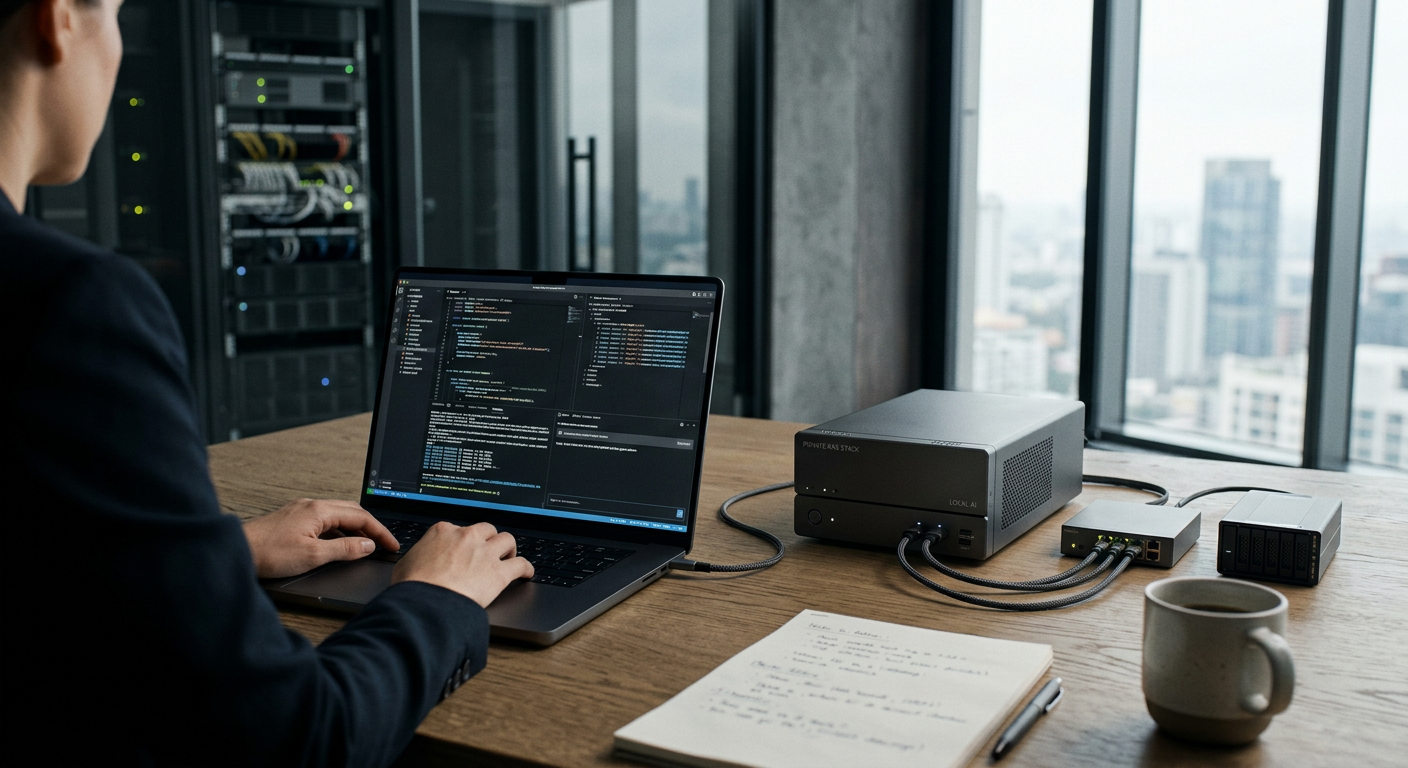
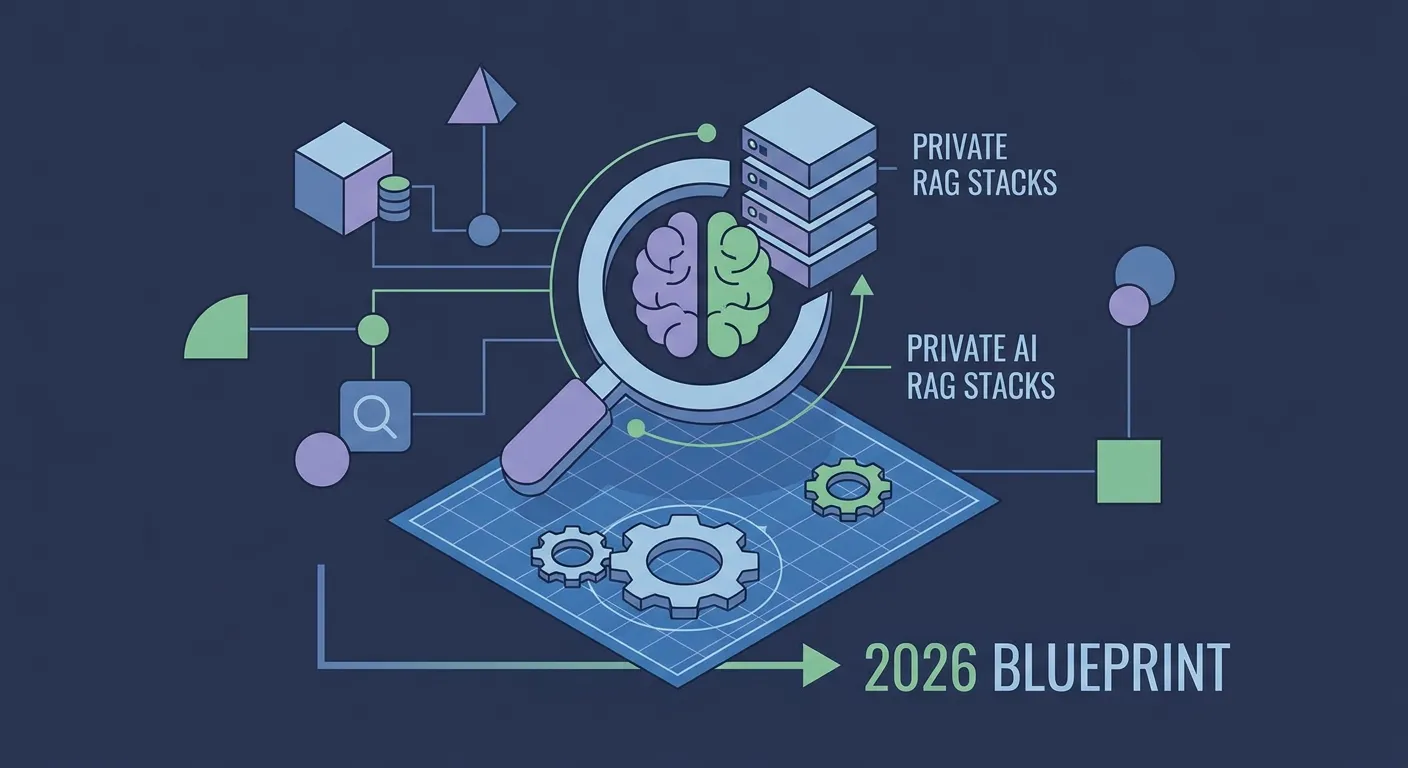
Local AI Search is an on-device query system that processes proprietary data without cloud dependency. It utilizes RAG (Retrieval-Augmented Generation) to connect localized Large Language Models directly to internal document databases. This architecture ensures absolute data privacy while delivering highly contextual, instantly queryable knowledge synthesis.
TL;DR Summary:
- Local AI Search combines on-premise Large Language Models with Retrieval-Augmented Generation (RAG) to securely query internal documents without cloud exposure.
- Replacing Google requires a composable stack: Ollama for local inference, LibreChat for the interface, and Kagi APIs for private web grounding.
- Cloud-based Search MCPs consistently fail at deep context; local hardware running models like DeepSeek provides superior, private synthesis for enterprise data.
The Core Mechanics of Local Retrieval
When I first started architecting internal search for a legal-tech client, I saw the same mistake repeated: developers conflating consumer-grade edge processing—like the basic motion detection in Reolink cameras—with true enterprise knowledge synthesis. This confusion isn't just semantic; it’s a budget-killer that misallocates engineering hours toward rigid, pre-trained classification tasks instead of dynamic reasoning.
True Local AI Search requires integrating localized Large Language Models with RAG (Retrieval-Augmented Generation). This combination transforms static files into a dynamic, queryable vector space. We are not building a worse version of Google for the open web. We are constructing an impenetrable internal knowledge graph for proprietary data.
No data ever leaves the host machine during this retrieval process. This strict isolation prevents external model contamination and protects intellectual property. It ensures that internal document search remains entirely deterministic and secure, a necessity for modern enterprise data management.
Why Hardware-Bound AI is the Future
Cloud-based search architectures introduce unacceptable vulnerabilities for proprietary enterprise data. Relying on external APIs exposes sensitive internal documents to third-party model training. The architectural shift toward hardware-bound AI eliminates these attack vectors entirely.
By deploying On-Premise Infrastructure, organizations achieve absolute Data Sovereignty. You control the hardware, the model weights, and the retrieval pipeline. This guarantees compliance with strict data privacy regulations while maintaining high-speed query performance. Organizations no longer rent their intelligence; they own it outright.
Why Cloud Search MCPs Fail
Cloud-based Search MCPs fail because they prioritize broad web indexing over the semantic precision required for proprietary data. These tools suffer from Search MCP + Context Degradation, leading to hallucinated outputs that lack relevance. True enterprise utility requires local, RAG-driven engines that maintain Data Privacy + Internal Documents without cloud exposure.
The Context Window Illusion
I recently audited a workflow meant to replace Google search for a research firm. The consensus was clear: current cloud-based Search MCPs are fundamentally broken for deep, technical queries. They provide shallow, generic summaries rather than actionable insights. When you offload queries to a third-party MCP, you lose the ability to fine-tune the retrieval process. The system treats your proprietary data as generic noise, resulting in poor, hallucinated results.
Data Privacy and the Vanta/Conveyor Dilemma
Many organizations attempt to bridge this gap using compliance-heavy tools like Vanta or Conveyor. While these platforms manage security documentation, they do not solve the underlying problem of data sovereignty. Relying on cloud-based search for sensitive information creates a massive, unnecessary attack surface. By building a local alternative, you bypass the need for external compliance layers entirely.
The Composable Local AI Stack
This composable stack is the direct, modular antidote to the context degradation and privacy risks inherent in cloud-based MCPs. By integrating Ollama for local model execution, LocalAI for API compatibility, and LibreChat for the frontend, developers create a secure, RAG-driven engine that replaces vulnerable cloud-based MCPs with high-performance, private, and fully autonomous infrastructure.
Ollama, LocalAI, and LibreChat
Building a resilient system requires a clear separation of concerns. I treat the inference engine, the API gateway, and the user interface as distinct, swappable modules. This modularity prevents vendor lock-in and allows for rapid upgrades as new open-weights models emerge.
Ollama serves as the primary backend for model inference. When I configured this for our internal research stack, I paired Ollama with LocalAI to bridge the gap between local execution and OpenAI-compatible API requirements. This setup allows LibreChat to function as a familiar, feature-rich interface while keeping all data processing strictly on-premise.
Hardware Requirements for DeepSeek Parsing
Performance in local RAG depends entirely on VRAM capacity and memory bandwidth. Parsing complex documents with models like DeepSeek requires significant hardware overhead to maintain low latency. I recommend a minimum of 24GB VRAM for stable, high-speed inference on modern quantized models.
| Component | Role | Hardware Tier | VRAM Requirement | Performance Impact |
|---|---|---|---|---|
| Ollama | Inference Engine | RTX 4090 / A6000 | 24GB+ | High (Low Latency) |
| LocalAI | API Gateway | Consumer GPU | 8GB - 12GB | Moderate (API Overhead) |
| LibreChat | Frontend UI | CPU / RAM | N/A | Negligible |
| DeepSeek | LLM Parsing | RTX 4090 / H100 | 24GB - 48GB | Critical (Context Depth) |
| Kagi API | Web Grounding | Network | N/A | Low (Latency Bound) |
When I deploy these stacks, I prioritize the RTX 4090 for its balance of CUDA core count and VRAM. Running DeepSeek locally for document parsing demands this tier to avoid offloading to system RAM, which kills performance. If you are parsing Claude-level outputs, you must ensure your VRAM allocation accounts for both the model weights and the KV cache.
Building Internal Document Retrieval
Local AI search relies on transforming Internal Documents into Vector Embeddings to enable precise, private retrieval. By implementing a local RAG Pipeline + Semantic Search, you bypass cloud-based vulnerabilities. This architecture turns static files into a queryable knowledge graph, ensuring your proprietary data remains secure, accessible, and instantly searchable on-premise.
Vectorizing Your Proprietary Data
During a recent deployment, we hit a wall with standard character-splitting; it destroyed the semantic meaning of our legal documents. We had to abandon standard chunking for semantic chunking to keep related concepts together. You must first convert your unstructured files into a machine-readable format using a local ingestion script to parse PDFs, Markdown, and text files into clean, uniform chunks.
Once chunked, pass these segments through a local embedding model. Store these resulting vectors in a local database like ChromaDB or Qdrant. This keeps your data sovereignty intact without relying on external cloud vector databases.
Optimizing the RAG Pipeline
Connecting your vector store to an LLM requires a robust retrieval mechanism. I focus on tuning the retrieval parameters to ensure the model receives only the most relevant context. We often implement a re-ranking step after the initial vector search. This secondary pass evaluates the retrieved chunks for semantic relevance before sending them to the LLM. It significantly reduces hallucinations and improves the quality of the final synthesis.
Stop Searching, Start Synthesizing
The shift from external search to internal synthesis is a strategic necessity. When you integrate your Proprietary Data + Local Intelligence, you move beyond the limitations of generic LLMs. You create a closed-loop system where context is never leaked to third-party cloud providers. Understanding the shift to generative search is critical for long-term planning.
Cloud dependencies are a liability that will eventually compromise your data integrity. Abandon the fragile, pay-per-token models that prioritize vendor profit over your operational security. Reclaim your autonomy by moving your intelligence layer on-premise.
Download Ollama today. Vectorize your internal documents. Build your local RAG pipeline. Stop searching and start synthesizing.