
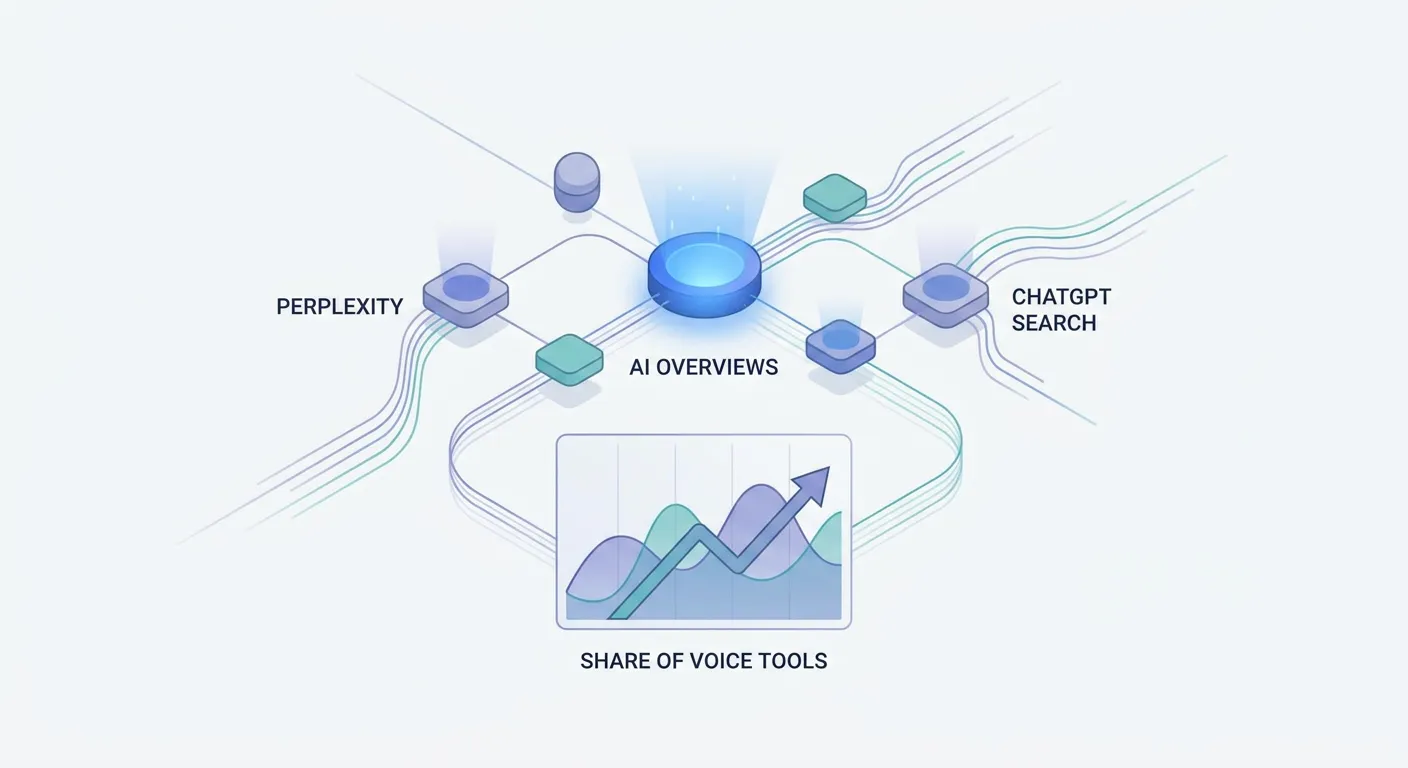
How do you strictly define AI Share of Voice in 2026?
Interviewer: Let’s start with a reality check. Why are so many GTM leaders still chasing vanity metrics while their pipelines evaporate?
Author: In late 2025, I sat with an enterprise software client who was popping champagne because they’d secured the #1 organic spot on Google for their core keyword. Two weeks later, they called me in a panic—their inbound pipeline had dried up. Our audit revealed the truth: they were invisible inside ChatGPT and Perplexity. They were winning the battle for blue links, but they were losing the war for AI-generated consensus. That’s when I realized that if you aren't tracking share of voice tools for ai overviews perplexity chatgpt search, you are essentially optimizing for a ghost town.
Interviewer: So, how do we define this new metric?
Author: AI Share of Voice is the percentage of times your brand is cited as a source or recommended in AI-generated answers across specific prompt sets. It’s not about potential traffic; it’s about actual brand recommendation logic. You need to move from tracking static rankings to measuring your presence in the conversational engines where your buyers actually live.
The Death of Traditional Rank Tracking
Interviewer: Why do legacy SEO tools fail to capture this new reality?
Author: Legacy tools track static indexes. They measure blue links. But LLMs don't use indexes; they synthesize information dynamically. If you rely on old-school rank trackers, you’re looking at a map of a city that no longer exists. You need to start with entry-level visibility tools like the HubSpot AI Search Grader to establish a baseline, but don't mistake that for a complete strategy. It’s a starting point, not a destination.
Why Mentions vs. Citations Matter
Interviewer: Is a mention in an AI response enough to move the needle?
Author: A mention is just noise. A citation is a signal. When an AI engine cites your brand, it provides a direct link back to your site, which is the only way to drive actual referral traffic. Your goal with Generative Engine Optimization is to increase your Citation Frequency. If you aren't being cited, you aren't part of the conversation.
Why are buyers abandoning Google for Perplexity Pro?
Interviewer: We’re seeing a massive migration toward Perplexity. What’s driving this behavior?
Author: It’s a trust issue. Buyers are tired of the hallucinations they get from standard chatbots. They’ve realized that Perplexity functions as a real-time fact-checker. When I tested it against standard models for B2B research, Perplexity bypassed the marketing fluff on vendor sites entirely. It went straight to Reddit and G2 to find out what users actually thought. Buyers want the truth, and they’ve realized that traditional search engines are too cluttered with SEO-optimized garbage to provide it.
The Hallucination Frustration
Interviewer: How does this impact the way brands need to show up?
Author: It forces you to be honest. If your product has a flaw, the AI will find it in a Reddit thread and cite it. You can’t hide behind polished landing pages anymore. The hallucination frustration is driving buyers to platforms that anchor every claim to a live URL. If you aren't providing verifiable data, you’re going to be filtered out of the answer entirely.
Real-Time Facts vs. Creative Generation
Interviewer: Is there a fundamental difference in how these engines retrieve information?
Author: Absolutely. Perplexity treats search as a retrieval task, not a creative one. It isolates factual claims before it even starts writing the response. This makes it a real-time bullshit detector. If your brand narrative doesn't align with the peer consensus found on third-party sites, the AI will simply ignore you. You have to build your authority outside of your own domain.
Which AI Share of Voice tools actually work right now?
Interviewer: Let’s talk tools. What should teams be using to track this?
Author: I remember migrating a client from a legacy suite to a modern stack. The moment we integrated Profound + Enterprise Visibility Analytics, the 'aha' moment hit. They saw they were ranking on Google but were completely invisible in the AI models their buyers were using. That visibility gap was costing them millions. You need tools that pair prompt-level tracking with an execution layer.
The 2026 Technical Comparison Table
| Tool | Primary Platform Coverage | Best For | Key Capability |
|---|---|---|---|
| Profound | ChatGPT, Perplexity, Google AI | Enterprise | Deep Visibility Analytics |
| Slate | ChatGPT, Perplexity, Gemini | B2B SaaS | Content Execution Layer |
| HubSpot AI Search Grader | Google AI Overviews | SMBs | Free Entry-Level Audits |
| Ahrefs | Google AI Overviews | SEO Teams | Hybrid SEO/AI Tracking |
Categorizing Tools by Use Case
Interviewer: How do you choose the right one for your team?
Author: If you’re an enterprise team, you need the granular data that Profound provides to justify your budget. If you’re a B2B SaaS team, you need Slate because it doesn't just report on your visibility—it helps you fix it. Monitoring without execution is just a vanity exercise. You need a tool that tells you what to write to close the gap.
How do you engineer content to win AI citations?
Interviewer: Many marketers still think long-form prose is the key to ranking. Is that dead?
Author: It’s not just dead; it’s actively hurting you. LLMs don't read marketing fluff; they parse structured data. If you’re writing 2,000 words of fluff, you’re making the model work too hard. You need to provide clear Entity Definitions and structured data so the model can map your brand to the user's intent instantly.
Structuring Data for LLM Parsing
Interviewer: What’s the most effective way to structure this data?
Author: Treat your pages like database entries. Use schema markup to define your pricing, features, and integrations. When you make it easy for the model to understand what you do, you reduce its hallucination risk. And when you reduce its risk, it’s much more likely to cite you as a trusted source.
The Power of Objective Comparison Tables
Interviewer: You’ve mentioned using comparison tables to trigger citations. How does that work?
Author: I had a client with a narrative-heavy pricing page that was invisible to AI. We stripped it down and replaced the content with a dense, objective comparison table. Within 48 hours, they were being cited in Google AI Overviews. The AI favored the table because it provided an immediate, verifiable answer. If your content isn't formatted as a dense matrix, you are invisible to the modern search stack.
What is your final warning to teams ignoring AI SOV?
Interviewer: We’ve covered the shift. What’s the final word for those still on the fence?
Author: Ignoring AI Share of Voice is a death sentence. I consulted for a legacy provider last year that refused to adapt to Generative Engine Optimization. They lost 60% of their market share in 2025. They waited for 'perfect attribution' while their competitors captured the LLM consensus. Don't be that company. Audit your visibility today, or prepare to be replaced.
The Cost of Inaction
Interviewer: Is it too late to catch up?
Author: The window is closing, but it’s not shut yet. If you wait for another fiscal quarter to update your infrastructure, you’re going to be left behind. The retrieval algorithms are getting more selective every day. You need to secure your position as a cited authority now, or you won't have a market to compete in later.
Your 30-Day Action Plan
Interviewer: What should a team do in the next 30 days to pivot?
Author: Stop measuring potential traffic and start measuring actual LLM consensus. Deploy a purpose-built tracking tool this week. Map your core product categories against specific prompts in ChatGPT and Perplexity. Identify your citation gaps, restructure your documentation into comparison matrices, and start monitoring your fluctuations weekly. Treat these metrics as your leading indicator for revenue. Audit your AI visibility now, or stop complaining when your pipeline dries up.